
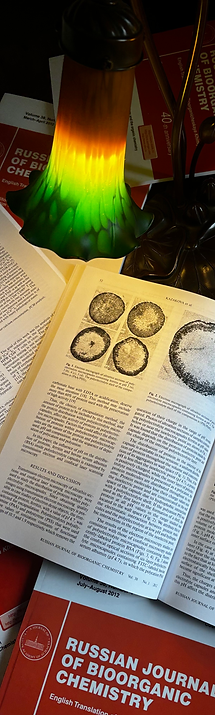
The Russian Journal of Bioorganic Chemistry was founded in 1975 by Academician Yu. A. Ovchinnikov. The editorial board uses the term "bioorganic chemistry" to encompass a wide range of scientific problems related to the study of the structure and function of biomolecules.
The journal is intended for scientists, medical professionals, university lecturers and students, as well as researchers in industrial, medical, agricultural, and environmental control laboratories.
The journal publishes articles devoted to research in the fields of bioorganic chemistry, biochemistry, molecular and cell biology, genomics, proteomics, bioinformatics, immunology, molecular virology, molecular evolution, and molecular developmental biology.
The journal is published 6 times per year. Publication of articles in Russian journal of Bioorganic Chemistry is free of charge. Manuscripts are submitted to the editorial office in Russian and are translated for the English version by a group of highly qualified translators (THEZA company) who are specialists in the relevant fields of bioorganic chemistry. The journal publishes reviews, mini-reviews, experimental and theoretical papers, hypotheses, and letters to the editor (short communications).
The Russian version of the journal (Bioorganicheskaya Khimiya) is published by the Russian Academy of Sciences. The electronic version of the journal (full texts) has been available on the website of the scientific electronic library eLIBRARY.RU since 2006.
The English version of the journal, "Russian Journal of Bioorganic Chemistry" (until 1993 – "Soviet Journal of Bioorganic Chemistry"), is published by Pleiades Publishing, Ltd. Full texts of the English version are distributed by the international publishing company Springer.
The journal is included in the List of the Higher Attestation Commission (peer-reviewed scientific publications included in international abstract databases and citation systems): the "List of Journals in International Databases."
Since 2000, the journal has been indexed by its English version and is included in the following bibliographic databases: AGRICOLA, BIOSIS, Biological Abstracts, CNKI, Chemical Abstracts Service (CAS), Dimensions, EBSCO Academic Search, EBSCO Discovery Service, EBSCO STM Source, EMBiology, Google Scholar, Institute of Scientific and Technical Information of China, Japanese Science and Technology Agency (JST), Journal Citation Reports/Science Edition, Meta, Naver, OCLC WorldCat Discovery Service, ProQuest Central, ProQuest Materials Science and Engineering Database, ProQuest SciTech Premium Collection, ProQuest Technology Collection, ProQuest-ExLibris Primo, ProQuest-ExLibris Summon, Reaction Citation Index, Reaxys, SCImago, SCOPUS, Science Citation Index Expanded (SciSearch), TD Net Discovery Service, UGC-CARE List (India), and Zoological Record. The Russian version is included in the databases EMBASE (Excerpta Medica), AGRICOLA, RSCI (Russian Science Citation Index), the Higher Attestation Commission list, and several others.

PEER REVIEW OF ARTICLES
In the Russian Journal of Bioorganic Chemistry, all articles undergo peer review. We use a double-blind peer review process conducted by a group of external reviewers (at least 2 reviewers per manuscript).
The group of reviewers includes 86 internal and external experts (of which 86% are external). The number of rejected manuscripts annually is about 78%. The final decision on the publication of a manuscript is made by the Editor-in-Chief.
Any invited reviewer who feels unqualified to assess the manuscript or cannot conduct the review due to a conflict of interest must promptly notify the Head of the Editorial Office and decline the invitation to review.
Reviewers should formulate their comments clearly, with reasoned arguments and logic, so that authors can use them to improve the manuscript. Any criticism directed at the authors personally must be completely avoided.
Reviewers should specify in their review:
(a) any works that are relevant to the manuscript but were not cited by the authors;
(b) anything that has been reported in previous publications but was not appropriately cited or referenced in the work;
(c) any significant similarity or overlap with other (published or unpublished) manuscripts of which the reviewer has knowledge.
ETHICS AND PUBLISHED INFORMATION
The Russian Journal of Bioorganic Chemistry strongly supports the principles of integrity and ethics in its published content.
The journal has a conflict of interest policy, and the published works comply with international, national, and/or institutional standards for research involving humans and animals, as well as utilizing the practice of informed consent when necessary.
The Russian Journal of Bioorganic Chemistry is a member of the Committee on Publication Ethics (COPE) and adheres to its principles regarding how to handle cases of misconduct, thereby committing to investigate allegations of misconduct in order to ensure the integrity of research.
We use plagiarism detection software when reviewing submitted manuscripts.
If plagiarism is detected, the journal will follow the principles and guidelines of COPE regarding plagiarism.

Collections of articles from the Russian Journal of Bioorganic Chemistry


Collection

Collection

Collection
